
When several people inherit one house, no single heir can usually sell the whole property alone. Each heir owns a share, and a clean sale needs the right people to sign, a clear title and an agreed split of the money. If your family wants a sale without repairs, listings or showings, we at Polus Acquisitions Group buy inherited houses as-is, and we work with all the heirs on one closing. We buy in Houston, San Antonio, Dallas and other U.S. markets. All offers are subject to inspection and transaction requirements.
This guide explains who has to agree, what to do when someone won’t, what happens to the money, and how to move forward as a group.
TL;DR
- Heirs who inherit together generally hold an undivided share of the whole house, so a sale of the whole property normally needs everyone’s signature or a court order.
- Who signs depends on the will, whether probate is open, and your state. An executor may have the authority to sign for the estate. In some states, such as Florida, a protected homestead passes straight to the heirs, who must sign.
- If one heir refuses, any co-owner can ask a court for a partition. Many states, including Texas, have rules that give the other heirs a chance to buy out the one who wants to force a sale.
- Mortgages, liens and estate debts are paid from the sale price at closing, and the rest is divided by share. Taxes on a sale of inherited property usually depend on the value at the date of death.
- A cash offer on the whole house lets all heirs sell once, as-is, with no agent commissions or listing fees.
Table of Contents
- What “multiple heirs” means for ownership
- Do all heirs have to agree to sell?
- What if one heir refuses to sell?
- Can one heir sell just their share?
- Getting the paperwork in order
- Where the money goes
- A worked example
- Why a cash sale suits a shared inheritance
- Request a free offer review
- Our view on selling with multiple heirs
- FAQ
- Sources
What “multiple heirs” means for ownership
When a person dies and leaves a house to more than one person, each heir gets what the law calls an “undivided interest.” That means each heir owns a share of the entire property, not a particular room or half of the yard. A land policy explainer on heirs’ property describes it the same way: each heir owns a share of the whole.
Three things follow from that:
- Every share counts. A buyer cannot take clear title to the full house unless every owner, or the person legally acting for them, signs off.
- Shares are not always equal. A will may split the house unevenly. With no will, state law decides who inherits and how much, and the list can grow with each generation.
- No one owns a room. One heir living in the house does not own the house alone, and the others do not have to move out to sell.
If you are not sure who the heirs are, start with the will, if there is one, and the probate file. Our guide to selling a house in probate walks through that part.
Do all heirs have to agree to sell?
In many places, yes. Because each heir has an undivided interest, a sale of the whole property normally needs every owner to agree. A summary from a law firm lists the usual exceptions: an executor or personal representative with authority under the will or state law, a court-authorized sale, and trust provisions. State law varies.
The question comes down to three facts.
Is there a will, and does it give the executor power to sell?
An executor is the person named in the will to manage the estate. Some wills give the executor a “power of sale,” which lets the executor sell estate real estate without asking each heir to sign. In Florida, for example, a personal representative with a power of sale in the will can sell estate real property without court authorization, under Fla. Stat. § 733.613. Without a will or a usable power of sale, the court has to authorize or confirm the sale before title passes.
Is the house still in probate?
Probate is the court process that settles a deceased person’s estate. While it is open, the executor or court-appointed administrator generally controls the sale, and the heirs often get their share after debts are paid. Some states add steps. In Oklahoma, estate real estate sales generally must be reported to and confirmed by the court before title passes, unless all heirs file written consents, according to a probate guide. In Ohio, an executor may sell with the written consent of the surviving spouse and all heirs, at a price of at least 80 percent of appraised value, per the same guide.
Is it a protected homestead?
In Florida, a protected homestead generally is not an estate asset. It passes directly to the heirs, who generally must sign the deed, and a Florida estate guide adds that an heir’s spouse may need to join if the heir made the home their primary residence. Other states handle homesteads differently, so check how your state treats it before you set a closing date.
In Texas, our Texas inherited house guide covers probate and heirs in more detail.
What if one heir refuses to sell?
This is the most common snag with a shared inheritance. You have three real options.
- Talk it through with numbers. Often an heir refuses because they don’t know what the house would net. Share a simple estimate of the sale price, the payoff on any mortgage, and each person’s share after costs. Our cash offer vs. listing calculator lets you compare net proceeds side by side.
- Let one heir buy the others out. If one heir wants to keep the house, that heir can pay the rest for their shares, usually based on an appraisal. If there is a mortgage, the buyer may need to refinance. Massachusetts, for example, explains that a co-owner who wants to keep the property can buy out the others, which may require paying off or refinancing a mortgage.
- File for partition. A partition is a court case that ends co-ownership. A judge can divide the property or order it sold and the proceeds split. In Texas, a refusing heir cannot block a partition, because co-owners have a right to ask for it.
Partition is a legal step, so talk to a probate attorney in your state before you file. It also takes time and legal fees, which come out of the family’s money.
Rules that protect family heirs in a partition
Many states now follow the Uniform Partition of Heirs Property Act. The National Consumer Law Center’s 2024 report says it has been enacted in 23 states and territories, including Texas, Florida, Alabama, Georgia and South Carolina. Where it applies, it requires:
- notice to the other co-owners;
- an independent appraisal;
- a 45-day window for co-owners to buy out the heir who asked for partition, plus 60 days to arrange financing;
- if a sale goes ahead, an open-market sale for no less than the appraised value.
These rules exist partly so that outside speculators can’t buy one heir’s share cheaply and force a sale. That matters to you for one reason: a court-run process takes longer and gives the family less control than a sale the heirs agree on.
Can one heir sell just their share?
Sometimes. In North Carolina, for instance, a co-owner can transfer only their own undivided interest without the others joining, and the buyer becomes a new co-owner who receives only that share, not the whole house. That kind of share is hard to market and usually sells at a steep discount.
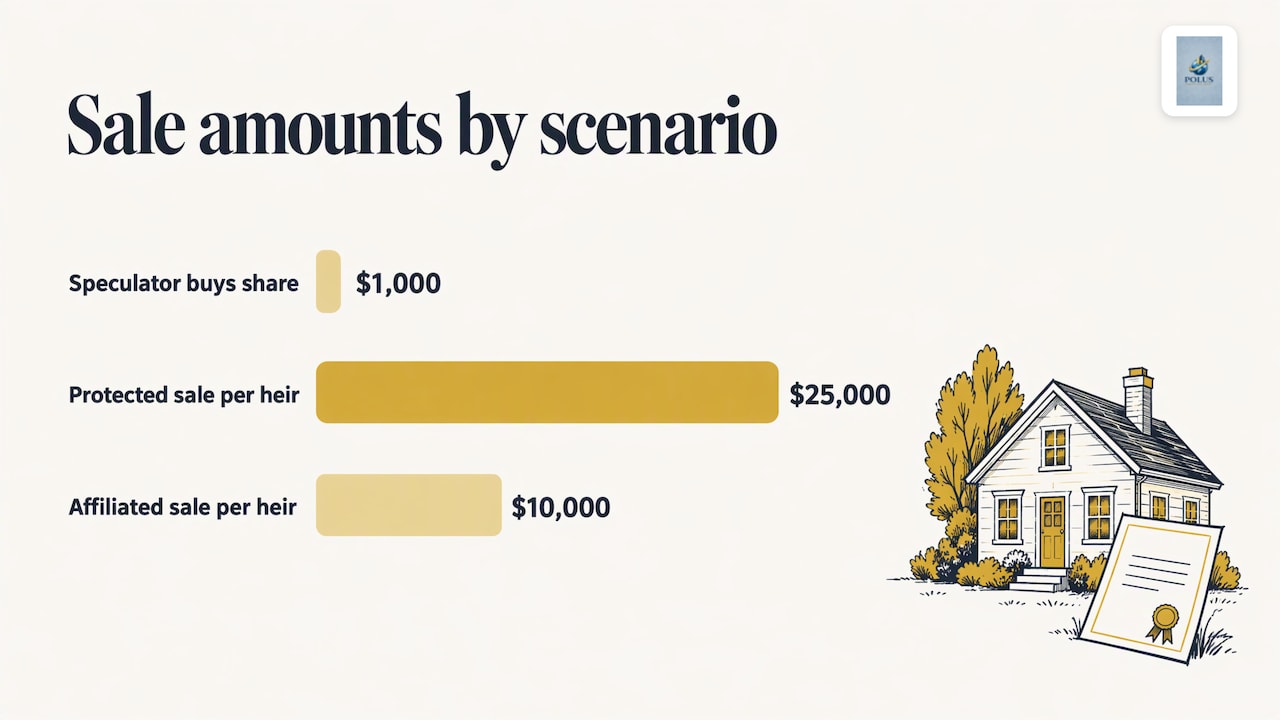
The NCLC report gives an example of what that can cost a family: a speculator buys a one-fourth share of a $100,000 home for $1,000. With appraised-value protections, each one-fourth owner would receive $25,000 from a sale. An affiliated $40,000 sale without those protections could leave each heir with $10,000. If your family sells together, every heir is paid on the whole house, not on a discounted fraction.
Getting the paperwork in order
Before any buyer can close, the title company needs to see who has authority. A good order of work:
- Confirm who the heirs are and their percentages. Use the will, or the state’s rules if there is none.
- Confirm who can sign. That may be an executor, an administrator, or every heir.
- Check probate and trust status. Find out whether a court has to approve the sale.
- Get a title commitment. It lists liens and issues that must be cleared.
- Get the mortgage payoff and lien details. Tax, judgment, HOA and mechanic’s liens all need a payoff or release.
That list follows an inherited property sale checklist. If the family never opened probate, ask a probate attorney which route your state uses to clear title, such as an affidavit of heirship or informal probate. The National Agricultural Law Center’s state survey shows these tools differ by state.
We handle the legal and paperwork side of complex sales directly with sellers, so the family isn’t coordinating it alone. Our inherited house guide lays out the full path.
Where the money goes
A sale of a shared house pays out in a set order at closing:
- the mortgage payoff, if there is one;
- liens, back property taxes and other title items;
- estate debts and expenses, if the sale is part of probate;
- the remaining proceeds, split among heirs by share.
If the house is worth less than what is owed, the heirs need to talk with the executor and an attorney before agreeing to a price. Estate debts are generally paid from the estate, and the details depend on your state.
Taxes on the sale
For federal income tax, your cost basis in an inherited house is generally the fair market value on the date of the decedent’s death, according to the IRS. If the house sells for about that value soon after, there is often little or no gain to report. Each heir reports their own share. Ask a tax professional about your situation, especially if the house sells for much more than the date-of-death value or if the estate is large.
A worked example
Say three siblings inherit a Houston house equally. The will names one sibling as executor with power of sale. The house needs a new roof and has a $60,000 mortgage payoff. A cash buyer offers $190,000 as-is, subject to inspection and transaction requirements.
- Price: $190,000
- Mortgage payoff: $60,000
- Remaining before other closing items: $130,000
- Each sibling’s one-third share before other items: about $43,333
This is an illustration, not an offer or a promise of any price. Real figures depend on the inspection, the title commitment and the closing costs. What it shows is the logic: one buyer, one closing, one payout by share, and no repair bills for anyone to argue about.
Why a cash sale suits a shared inheritance
A listing asks several people to agree on a price, a repair budget, an agent, showing times and who pays the carrying costs while it sits. Each of those is a chance for a disagreement. A direct sale cuts that list down.
- One decision about price. Heirs review one offer on the whole house.
- No repairs. We buy houses in any condition, so nobody has to fund or manage a rehab.
- No agent commissions or listing fees.
- A closing date the group chooses. Closing can be in as little as 10 days, when title and all signers are ready.
- Out-of-state heirs. Heirs who live elsewhere can take part without traveling to the property.
For local detail, see our guides for Houston and Dallas.
Request a free offer review
If you and your co-heirs are ready to see numbers, we offer a free, no-obligation cash offer review. Send us the address and tell us who the heirs are and where probate stands. We’ll talk with you in plain terms about what comes next. You can request your cash offer online or call (281) 771-1395. We buy in Houston, San Antonio, Dallas and other U.S. markets, and every offer is subject to inspection and transaction requirements.

Closer to Houston or San Antonio? See our pages for Houston and San Antonio.
Our view on selling with multiple heirs
The hardest part of a shared inheritance is rarely the law. It is the family. One sibling wants to move on, another is attached to the house, a third lives out of state and hasn’t seen it in years.
We believe the best path is the one that lets everyone say yes at the same time. That means a plain number, a clear list of who signs what, and a closing date the family picks. We buy houses as-is, with no agent commissions or listing fees, so there are fewer things to disagree about.
We also think heirs should know their options before any one of them signs anything. Get the title facts, know the payoff, and read the offer together. Our offers are subject to inspection and transaction requirements, and we say so up front.
Since 2015, we have bought over 200 homes. Probate, title questions and out-of-state owners are situations we work through with sellers regularly, and we handle the paperwork directly.
Ammanuel
FAQ
Can I sell an inherited house if my siblings don’t agree?
It depends on the will, probate status and your state. An executor with the right authority may be able to sell, and a co-owner can ask a court for a partition. Talk to a probate attorney in your state before taking either step.
Who signs the sale of a house with multiple heirs?
If the estate is in probate, usually the executor or administrator signs, sometimes with court approval. If the house passed directly to the heirs, every heir generally has to sign. A title company will tell you exactly who is needed once it runs the title.
How long does a multiple heirs sale take?
It depends mostly on how fast the heirs agree and how clean the title is. With everyone ready, we can close in as little as 10 days. A court-supervised sale or partition usually takes longer.
Do we have to repair the house first?
No. We buy houses in any condition, so the family doesn’t have to repair, clean out or stage the home. Offers are subject to inspection and transaction requirements.
Are investors able to buy inherited properties?
Yes. We also keep a buyer list that gives investors and retail buyers access to off-market properties. Investors can join the buyer list to see what we have.
Sources
- Understanding Heirs Property
- Do All Heirs Have to Agree to Sell Inherited Property?
- Selling a House During Probate in Florida
- Does Selling a House in Probate Need Court Approval?
- Selling Inherited Property in Florida: Who Has to Sign?
- Partition cases in the Land Court (Mass.gov)
- What Happens If an Heir Refuses to Sell in Texas
- Keeping It in the Family (NCLC, 2024)
- Can I sell just my share of the property?
- Inherited Property Sale Readiness Checklist
- Heirs’ Property State Survey (National Agricultural Law Center)
- Gifts and inheritances (IRS)